Categories
Culture Patter

Sir Big Yin

Sir Billy Connolly has officially retired from stand-up comedy after a career spanning 40 years, we discuss his legacy that paved the way for comics all over the world and how will it feel losing our very own Court Jester. Listen to our latest Culture Patter Podcast Below or on all podcast platforms – @ThePatterPod


By Shaun Forrest & Jamie Watt

The Barras Market has long been a place for wheelers and dealers. If you needed anything, ‘down the Barras’ you went. A hive of working-class people haggling for clothes, curtains and records. Sir Billy Connolly’s dad would buy records for him, Slim Whitman and Hank Williams would sculpt the beginning of Billy’s affection of American Country and Folk music. Billy would make music his hobby, going to gigs around Scotland where he developed his style, idolising bohemian rock stars and embracing the Sixties folk scene. Billy would romanticise the Folkie lifestyle, he would pluck his banjo whenever he could while writing songs about his life and aspirations.

The mentality of Glasgow’s working class in the 1960’s was that men should commit themselves to earning a decent wage by grafting at the shipyards of the Clyde. This is where a young Connolly inevitably ended up, but harboured unique aspirations. Billy once confessed his dream of leaving the Clyde Shipyard forever to a Willie McInnes who told him to walk out on the spot and pursue his dreams. Willie had seen too many men become depressed and regretful on the yard, men who could have followed their dreams but instead kept their head down and buried their desires. This advice not only spurred the Big Yin to escape the Shipyard but might have been the realisation he could escape the miserabilism of Scottish life entirely. Afterall, The Big Yin now resides in the Sunshine State. 

“And I look at these Scots on tele, they are sort of singing shortbread tins, it’s the whole nation, they are singing about this garbage, hills and rivers.”

Connolly has vocalised how difficult he finds it to reconcile his socialist politics with flag-waving nationalism, and his frustration with the sentimentalised ‘tea-towel’ depiction of Scotland. During the run up to the 2014 Independence Referendum, he stood in the middle and declared he felt more connected to the men who worked in the Liverpool Shipyards than the Nationalists. However, his feelings changed after Brexit claiming an independent Scotland was now a more favourable option as long as the Nationalist “Tartan Bastards” don’t get carried away. 

“I think the comedian, like the poet plays an incredibly important role in society. He should be able to spot the absurdity in something that is just accepted.’’

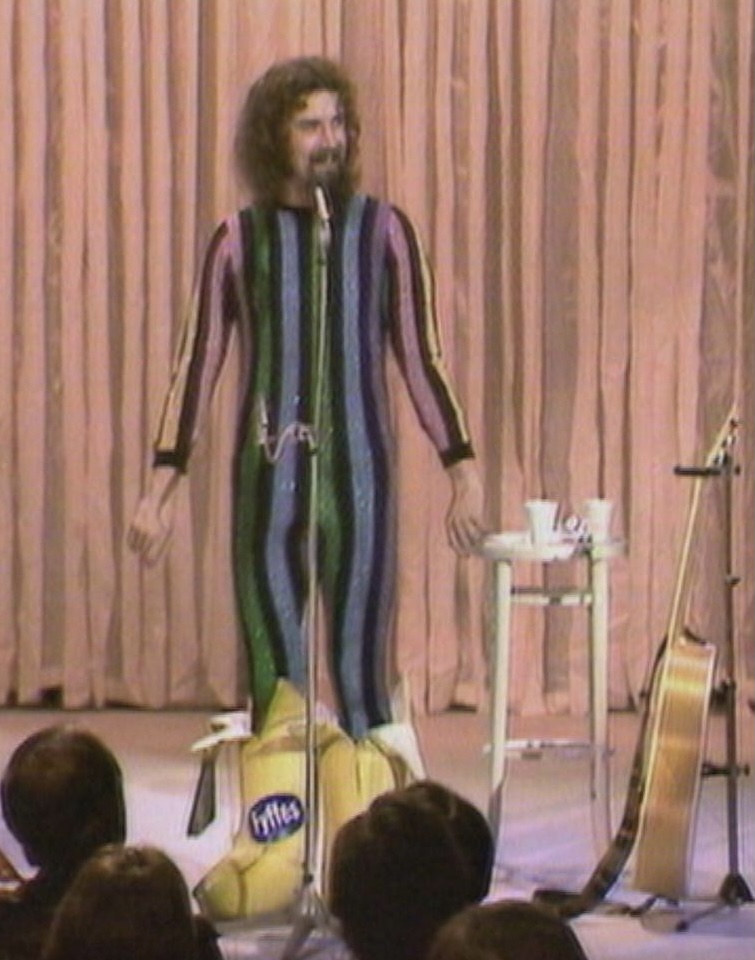
In modern comedy you will expect to watch people preform observation or situational acts, gags about things we can all relate to. Conolly’s ability to find humour and absurdity in the mundane was unrivalled, be it a floating jobby in a public toilet, the scenes of a house party or losing your virginity. Stories told every day in the pub were now being told on a stage with a theatrical twist. Billy effortlessly timed his physical comedy with these hilarious tales while clad in flamboyant attire, skin-tight trousers, vibrant shirts, banana shoes or a multi-coloured bodysuit. Evoking the figure Medieval Jester, Billy understood he had to complete the act by looking the joke. 

The Jester is symbolic of common sense and honesty. He holds the ability to peer through the bullshit and hypocrisy of society and make light of the everyday tragicomedies we all experience, without fear of retribution. The Jester’s role was to find humour in the unmentionable, to make an audience feel safe in laughing at the taboo because the attention was all on him. Like the Court Jester, Connolly was daft, irreverent and carnivalesque. He mixed physical comedy with the scatological and self-persiflage humour. His language was guttural and rich with expletives. He turned swearing into an art form and celebrated the infinite plasticity of the word ‘fuck’. Billy Connolly became so recognised as the nation’s official modern Jester he could tell the Queen to fuck off and still get a laugh from the Royal Box.

A comedian’s responsibility to explore and agitate the boundaries a society’s values never goes without its controversies. One particular story, told during his 1974 Solo Concert show, propelled him into the spotlight for both hilarious and contentious reasons. In the act, appropriately named The Crucifixion, Billy set the scene of the Last Supper but highlights the Bible’s misprints. This iconic religious event actually took place in Glasgow’s Gallowgate, more specifically the famous Saracens Head pub. The story portrays the apostles as a bunch or rowdy drunks waiting on the ‘Big Yin Jesus’ before he ends up crucified and giving the Romans abuse for having shite patter. The joke, by modern standards doesn’t appear overly offensive, but in a bigoted fuelled 1970’s Glasgow this was condemned as utter blasphemy. But protests from priests and Godfearing followers wouldn’t deter Billy or make him express regret, declaring it would be fascist if he apologised for having a point of view. 


Categories
Podcast Patter

Culture Patter #1 – Scottish Miserabilism (Ep8)

Jamie, Ewan, Shaun & Luke discuss a condition we all suffer from, chronic Scottishness or more specifically a symptom of this life long affliction, Scottish Miserabilism. Much of Scotland’s cultural output is synonymous with tragic down and outs, bleak realism and the negative story, we want to ask why?

Categories
Culture Patter

Scottish Miserabilism

This week we discuss a condition we all suffer from, chronic Scottishness or more specifically a symptom of this life long affliction, Scottish Miserabilism. Much of Scotland’s cultural output is synonymous with tragic down and outs, bleak realism and the negative story, we want to ask why? You can find our latest Culture Patter Podcast below or on all podcast platforms – @ThePatterPod


By Jamie Watt

‘Scottish Miserabilism’ – not a genre perse but a trope, a dark vein that runs through the cultural landscape of our nation. Engrained in our collective psyche, it influences how the world views Scotland and how we perceive ourselves. Much of Scotland’s artistic output is synonymous with tragic down-and-outs and bleak realism. We want to discuss ‘why?’

What are the contributing factors of SM, what historical events made the negative story so enduring in Scotland? 

Socio-economic issues and legacy of Thatcherism has undoubtedly influenced modern Scotland. The deindustrialisation of the 80’s pushed proud workers into unemployment, unsatisfying jobs or poverty. Drug use spiked, as did gang violence, vandalism and incarceration. During this period naturalistic writers of ‘Clydesideism’ like James Kelman and William McIlvanney became key voices in Scottish literature. Kelman’s Miserabilist masterpiece ‘How Late it was How Late’, controversially won the 1994 Booker Prize. Throughout this period, the failures of the Modernist vision of council estates came into focus. Communities were uprooted and housed in beak, cold environments, lacking in recreational facilities. They fell victim to neglect from council authorities, under pressure from increased budgetary cuts. These environments quickly descended into post-industrial wastelands. The council flat has become emblematic of one extreme of the Caledonian Antisyzygy (the duelling polarities within the Scottish psyche) the other being the High Romantic Highland castle. 

Miserabilism can be understood as a retaliation against this Romantic, idealised notion of Scotland, prevalent until the early 20th century. A repudiation of the twee, coothie, over-sentimentalised, shortbread tin depiction of Scotland. And, despite the self-perpetuating negativeness of miserabilism, it can have constructive role in analysing the hypocrisies, shortcomings and taboo subjects of modern Scotland. Transgressive in tone, is used by artists to commentate and bring into focus the ugly realities of the marginalised in Scotland. SM can spark debate and, at best, become a catalyst for social change.  

Is Scotland suffering from a Calvinist hangover? Does it play a role in the evolution of Miserabilism? A strict Presbyterian doctrine manifest in Scotland in the 16thcentury, as the Kirk preached the humble life was the path to paradise – sticking your neck out or being ambitious were frowned upon. Is this attitude the embryonic Caledonian Cringe? – The doctrine of self-hatred that refers to the Scots’ lack of personal and political confidence in their ability to govern themselves.  

Scotland’s populous is demonstrably inclined to be more pessimistic by nature. One 2015 poll suggests Scot’s are 5% more likely to believe they’re going to hell compared to Britain as a whole, with 14% believing they await a fiery fate.https://www.scotsman.com/news/uk-news/i-will-go-hell-one-seven-scots-fear-1495727

Is SM and the Caledonian Cringe a symptom of a lack of national confidence? Modern Scotland find herself in a unique constitution situation. There is an ambiguity surrounding what ‘Scottishness’ is. Despite being one of the oldest nations on earth our parliament is only 25 years old. At present we are a pseudo-nation, within a Union whose future grows increasingly unclear. We are a wealthy nation but generations of political miss-management at home and under Westminster rule has meant, historically, one of Scotland’s truths is extreme inequality. 

How Scotland is portrayed in art and media matters. Prior to the 2014 Independence Referendum David Cameron met with Sony over the release of Outlander. The establishment feared it would fuel nationalistic sentiment and manged to delay release. There was a political incentive, to repress the celebratory or Romantic notion of Scotland. These pieces of film/media/art have influence, they seep into the national psyche. Is it in Unionists’ interest to perpetuate Miserabilist stereotypes?

After recording this episode, we acknowledge the difficulty that we had, as four Scots, in discussing Scottishness – it became like fish trying to describe water. We live and breath a Scottish reality and the aspects and qualities we think are unique to Scotland might be anything but. However, rather coming to concrete conclusions our objective with the Pater Podcast is to discuss and explore. We welcome any feedback or critiaue, so please get in touch.


Categories
Podcast Patter

Social Patter #1 – The Scottish Drug Epidemic (Ep7)

Ewan, Luke and Shaun talk over the drug related deaths and addiction in Scotland. In December 2020 the Scottish Government released a devastating statistic that in 2019 Scotland’s drug related deaths increased a further 6%, doubling in a short five years. We ask the questions of how we got here, what are the important social issues that simply don’t work and is decriminalisation the answer?

Categories
Social Patter

The Scottish Drug Epidemic

The Scottish Government released the 2019 Drug Death statistics for Scotland which has again pushed our country further ahead which actually means horrendously behind every other European country. We discuss the potential cause for Scotlands addiction, the governments social mistakes and what could decriminalisation look like?

You can find the latest Social Patter Podcast below or on all podcast platforms – @ThePatterPod


By Shaun Forrest & Ewan Maguire

During a time of uncertainty, isolation and the ‘new normal’ Scotland released what has become the ‘too normal’ statistic that drug deaths around the country have risen again. In 2019 the recorded drug related deaths were 1,264 a six percent rise from 2018 and double the number of deaths from 2014. 

The root of Scotland’s drug addiction comes from Scotland’s poverty issue, the harsh deindustrialisation of the late 70’s that forced our communities into unemployment is not just a coincidence. The working men of our council estates would turn to alcohol and drugs to ease the daily pressure of being dragged down by the system they can’t control. Thatcherism increased our unemployment rates across the country to 12.9% leaving no real prospect for the new generation who are being born into poverty.

The majority of addiction in Scotland right now is from people who have battled addiction for over 20 years, children born into a broken Scotland that haven’t been given the correct tools or guidance, forgotten about or locked away. The majority of deaths have come from these people relapsing because for one reason or another the support they may have received just wasn’t enough.

Countries across the world have decriminalised drugs, this idea in Scotland has been backed by the SNP with a proposal for safe spaces where addicts can at least take drugs in a safe environment, but Westminster again knocked the proposal back. The older generations may still believe the ‘War on Drugs’ is the appropriate response but surely it is time to understand our past mistakes. Drug addiction and death hasn’t always been treated as a health issue, but it is far broader than that, it is a social and economic issue also. If we can’t financially support our working-class communities to survive, give them opportunities in education, teach the fundamentals, or create something for people to do, then why are we so shocked they turn to drug use. I’ve heard it all my life that youths hanging around streets are trouble but yet we still have nowhere for them to go, nowhere for lower income children to engage with professional role models, creating an environment that education and creativity is encouraged or normalised.

Decriminalisation doesn’t mean legalisation; it doesn’t mean people will run out and start taking drugs. Instead of people being put in prison they will be given the opportunity to recover from their addiction. In prison people are given help and support from professional addiction workers, nurses, mental health specialists and prison officers. A structure and routine are created to best suit the individual giving them the ability to manage their issues before being released. Unfortunately, the same care doesn’t continue when they are back into the community due to underfunding. It is ultimately easier to manage a recovery program in a controlled prison environment but without proper funding it will all be for nothing long term. But if someone wasn’t sentenced to prison for 12 months but instead given the correct support what might it look like. The average cost of keeping someone in prison for 12 months is £30,000 which works out to £576.93 a week but outside of prison the same person receives £102 a week. In prison people are given the opportunity of rehabilitation, recovering from drugs, given a job within the prison that could result in a Scottish Vocational Qualification (SVQ). Facilities to exercise with instructors, education, social workers and not forgetting three meals a day.

The question is not why is prison so good at dealing with the issue, it is why is our support in the community so bad?

***
I work in a community rehab offering support to those struggling with alcohol and drug issues. It is not an abstinence-based service but rather is centred around each individual’s goals (although these goals can be complete abstinence). It puts no prescriptive expectations on people beyond a desire on their part to cut down use and make improvements through structured engagement. Working within addiction services you are faced each day with the reach and limitations of the support you can offer to people. Although the person themselves must do the hard work of achieving and maintaining their desired end, we are there to offer education, intervention, community inclusion, the facilitation of peer-support, and groups that address common difficulties and new coping strategies.  

At points the job consists of fire-fighting, or “crisis management”. At these times, the importance of setting out a structured programme for individuals based on their own requirements and the strengthening of resolve and readiness must be put secondary to immediate intervention. I think this aspect of the job will not strike anyone as surprising. But what people might be less familiar with is what work is done when someone is stable and in a secure enough position to work on their “Recovery”. Even this term might be unfamiliar to some. It is the standard term for the condition of those who are actively pursuing a life free from addiction. The connotation it carries of continual work, rehabilitation and precariousness are important; but so are the connotations of creation and hope.

Those embarking on recovery can start that journey at a low point. Hospitalisation, ostracisation from partners or family, overdose attempts, or a slow and bleak realisation of the misery now attendant upon them. Some walk away before “rock-bottom” but others only resolve to change when faced with physical and mental self-destruction as an alternative. At whatever point they enter recovery, people invariably require help to build up self-worth and self-belief they have lost or may never have had. Alongside this, people benefit from exploring why addiction has affected their life and through what means the addiction has come to possess the strength that it does. Through these means, individuals can come to better understand how they came to be where they are and how to move progressively further from a way of life they no longer wish to lead.

This disentanglement of cause and effect, both in terms of personal background and day-to-day behaviour, allows an informed and personalised plan to emerge -a plan that may need repeated revision. This plan can be a way out of old, entrenched behaviours. This process can go further and this disentanglement, for those who are able to go through it, can also point to a general or specific cause, often a number of them. For some, counselling and difficult self-reflection can start to allow them some form of healing. For others, this cannot be achieved and they might learn to grow around past events. Others still remain plagued by them or unable to conceive of a life outside of addiction. For these people, a reactive approach to addiction is not enough; some early preventative measure was the only chance they stood. 

At this point, our society is failing to identify and target at risk populations with early preventative measures. These substances are addictive. If you are moved to take them repeatedly to counteract trauma, poor mental health, or any issue you feel unable and unequipped to deal with, addiction will ensue. And when addiction appears, no one can foresee where things end.


Get Help

Seek help from GP.

https://www.nhs.uk/live-well/healthy-body/drug-addiction-getting-help/ – more information and to find your local drug services.

Frank drugs helpline on 0300 123 6600 – https://www.talktofrank.com

https://www.wearewithyou.org.uk/ for online help.

https://www.sfad.org.uk


Reference: https://www.conter.co.uk/blog/2018/5/28/on-drug-use-consumerism


Categories
Podcast Patter

From Trump to Biden, I walked these streets with you. (Part 2 – Ep6)

I was joined again by Luke, Shaun and Jamie to move our timeline on and Discuss Biden’s 20th of January inauguration and Trump’s farewell speech at Andrew Air Force Base, Maryland.
We conclude with a discussion of how Trump’s administration might be remembered and our own personal highlights from his four years as President of the United States of America.

Categories
Podcast Patter

From Trump to Biden, I walked these streets with you. (Part 1 of 2 – Ep5)

The four of us got together to discuss the US election of 2020 and the inauguration of 2021, taking in all incidents in between. 
In part one of this two-part series, we talk election results, “stolen election” accusations, the “Save America” rally and the subsequent scenes at Capitol Hill.

Categories
Current Patter

From Trump to Biden, I walked these streets with you

Well it has actually happened, Trump has left the building. We take a look back at the outrages few weeks on the lead up to President Biden’s inauguration and the calm after the storm. You can find the latest Current Patter Podcast below or on all podcast platforms – @ThePatterPod

Don’t read this half-baked pish. Listen to the pod!
A Smudged Picture of Capitol Hill 

By Ewan Maguire

Democracy insists upon participation and democracy must take to heart the noise of those who cry out against real and perceived oppression. At first It really should take these two protestations to heart to the same degree. To real oppression it owes a righting of wrongs, a plan and a progression towards justice (in reality this process can be slow-moving, many instances taking generations, lifetimes or still, to this day, enduring). To perceived oppression it owes an explanation, a demonstration of facts and counterchecks. But what to do if this explanation is not accepted, is not believed, or is ignored?

If a small faction does not accept an explanation, or forgoes it all together, they might be ignored with the belief that they will gutter and extinguish from lack of oxygen. If a large and violent faction are unsatisfied or further provoked by an explanation, another tact must be taken. It feels, at least during this scenario, that either the protest will not go out by itself, or, for that matter, cannot be left to go out by itself because of the possible damage caused in the process. Retaliative violence is not condonable, nor is it productive. So, how do you convince earnest people that they have misplaced their convictions?

A leader’s mea culpa might sway some. But then a leader often becomes a representation, forged early -an idea that can outlast the real utterances and behaviour of the person. A leader’s retraction is always in danger of being seen as a betrayal by that person of the ideal of the representation.

 The trench-deep question remains of what this representation means to those who vaingloriously wave it as a flag and feel led by it to the steps of Capitol Hill. Has a real resonance moved between people who want something constructive, who stand for something that constitutes a betterment? I hear no solidarity for working people, no discernible manifesto. What I do hear is anger and ignorance and nothing else in earnest. Besides these, there may be no other convictions to contend with here.

***

I feel torn over writing that last sentence. I feel a slight guilt for judging those who are not the conscientious and calculating members of this patchwork movement that saw Trump for what he could be made into: a half-empty route through which their paranoid ideology could travel from rickets-inducing bedroom-obscurity to national conversation. Beyond the anger and behind the hysteria, there might be questions people want answered and issues they feel impotent to influence. 

What has to go so wrong to enable a fertile ground for conspiracy and enraged fantasy? Are critics guilty of oversimplifying and lacking a desire to understand where this swelling comes from? If this phenomenon can be understood, and we are not wasting our time by trying to make sure Hannibal Lecter understands what he did wrong, I cannot see any underlying issues being addressed if they remain manifested in an impenetrable cloud of conspiracy and aimless malcontent. It may fall to those who feel a visceral disagreement with the most visible elements of this movement to investigate if anything coherent can be made out of the tumult. 

Separately, for those working-class Americans who saw Trump as a means to gain attention unforthcoming from the wilfully amnesic administrations of the past, sympathy must be felt and an overdue righting of wrongs must be made. 

Part two of our two-part take on Trump’s presidency and Biden’s inauguration.
Categories
Podcast Patter

Current Patter #2 – Dark Waters (Ep4)

In the midst of the COVID-19 pandemic, a similar cultural phenomenon has occurred. Millennials and Gen Z have resurrected a 200-year-old sea shanty, returning to the folklore of the past to make sense of these perilous times.

Categories
Current Patter

Dark Waters – Sea Shanty

Has Tik-Tok become our Covid collaboration? A young Scottish man has taken over the world by resurrecting the old tradition of a singing sea shanty. You can find the latest Current Patter Podcast below or on all podcast platforms – @ThePatterPod

The Appeal of the Anachronistic, Neo-medievalism & Resurrected Sea Shanties

By Jamie Watt

The more society is unsettled by The Now, the more the future seems opaque and uncertain – then humanity will increasingly return to the visual language, narratives and values of the past.

We observed this at the turn of the Millennium. As the spectre of Y2K floated in our collective consciousness, the optimistic anticipation of the 21st Century quickly waned and turned to trepidation, as we began to ask ‘what unprocessable horrors lurk in the shadows of The New?’ A kind of Techno-Gothic became the pervading aesthetic as films like The Matrix channelled our insecurities and fears surrounding humankind’s relationship with emerging technologies. 

The reality wasn’t as cataclysmic as the Matrix depicted but was a longshot from the utopian portrayals of 21st Century life as seen in Atomic era fiction like Lost in Space and the Jetsons. Rather, a digital malaise took hold. The Computer, once synonymous with technological wonderment became, for many, a symbol of office drudgery and uninspiring work environments. Despite being increasingly ‘connected’ via the rapidly expanding internet, early 21st Century workers felt isolated, alone in a matrix of office cubicles surrounded by the cold sterility of desktop devices. 

Instead of looking to technology or the future for remedies, people turned to the past.  

Medieval cosplay and role-playing events became increasingly popular as disenchanted office workers rejected modern technology (at least for the weekend) and found escapism in feudalism. They clad themselves in leather tunics, and attended historical reenactments or ‘Renaissance Pleasure Carnivals’, trading the plastic computer keyboard for a hand-crafted wooden tankard, overflowing with mead. ‘Neo-medievalism’, the preoccupation with the Middle-Ages, permeated pop-culture with films like Shrek and The Lord of the Rings ruling the box office in 2001. Likewise, turn-of-the-millennium computer games such as Age of Empires and Diablo adopted an anachronistic mise-en-scene. Those who felt undervalued, as replaceable cogs in the corporate machine, could play out their fantasies as legendary knights or revered wizards in sprawling Medieval worlds.

Jump forward twenty years, in the midst of the COVID-19 pandemic, a similar cultural phenomenon has occurred. Millennials and Gen Z have resurrected a 200-year-old sea shanty, returning to the folklore of the past to make sense of these perilous times. 

A rendition of the early 19th century sailor’s song ‘The Wellerman’ by Airdrie postie, Nathan Evans went viral on Tik-Tok recently, racking up millions of views around the world and taking an older version of the song to the top of the global charts. The ballad tells the tale of life aboard a whaling vessel. 

It’s ironic that during a 21st Century plague, when our only path to normality is via cutting-edge epidemiological breakthroughs, that so many should find comfort in the pre-industrial sea shanty. Why do we look for comfort and meaning in the anachronistic at time of crisis? Discussing Neo-medievalism, Umberto Eco argued it is because many of the structures that define the Western world; modern languages, cities and economies have their roots in the Middle-Ages. We look back to their origins to chart their evolution, to identify where the faults in our modern institutions lie, a kind re-assessing/ trouble-shooting exercise. The more disillusioned we are with the contemporary word the more we will seek solace in the past, security in the old. 

During this pandemic, as we struggle with social isolation and economic uncertainty, we’re looking to epochs that conjure a sense of harmony and spiritual unity. A song about a whaling ship, an environment of order and discipline, where every shipmate had an essential role to fulfil and was valued, perhaps resonates with Tik-Tok’s demographic: A young audience of zero-hour contract holders at the mercy of precarious gig economy, who’ve been hit hardest by the economic fallout of COVID-19. John Archer, a folk singer from New Zealand, claims the success of the song is down to the similarities with the young whalers’ situation some 200 years ago and young people today, facing an uncertain future: The shared sense of being lost at sea, as the frenzied COVID-whale pulls us through the dark water. The appeal of the decisive sea captain mentioned in the song at a time when contemporary leaders appear inept, may also help to explain the songs popularity. 

Tok-Tok enables its users to edit any video, letting those around the world to add instrumentation, sing along and harmonise with Evans’ original acapella video. The result is a piece of constantly evolving media that conveys a sense of community and solidarity in turbulent times.