On this podcast, Luke, Shaun, Jamie and Ewan discuss serial killers. The fascination with true crime and serial killers seems to be growing endlessly and have a hold on a wider audience than ever. Like in the instance of poor Paul Krendler, Hannibal Lecter has direct access to our cortex and has set about consuming it in the most indelicate way. What does it mean that we are drawn to programmes about the lives of people whom (from most of us) we hope never to meet the likes of?
It is Sunday afternoon, preferably before the war. The wife is already asleep in the armchair, and the children have been sent out for a nice long walk. You put your feet up on the sofa, settle your spectacles on your nose, and open the News of the World. Roast beef and Yorkshire, or roast pork and apple sauce, followed up by suet pudding and driven home, as it were, by a cup of mahogany-brown tea, have put you in just the right mood. Your pipe is drawing sweetly, the sofa cushions are soft underneath you, the fire is well alight, the air is warm and stagnant. In these blissful circumstances, what is it that you want to read about?
ll that cold blackness -This time on the podcast, Shaun, Luke and Ewan discuss the likelihood of alien life and what it could mean for us. Listen to our latest Culture Patter Podcast below or on all podcast platforms. – @ThePatterPod
What is out there beyond the stars of Hollywood in that military base in Nevada?
Is there a government cover-up of alien life, or are aliens a welcome cover-up used by government lifeforms?
What is there to find and are we certain we want to find it?
“No one would have believed in the last years of the nineteenth century that this world was being watched keenly and closely by intelligences greater than man’s and yet as mortal as his own; that as men busied themselves about their various concerns they were scrutinised and studied, perhaps almost as narrowly as a man with a microscope might scrutinise the transient creatures that swarm and multiply in a drop of water.” – War of The Worlds
In this episode of the Patter Podcast Jamie, Luke, Ewan and Shaun dissect ‘fear’ – what our phobias are rooted in, how they manifest and how they’ve evolved to reflect our changing times. We discuss why certain characters and tropes are revisited in the horror genre whilst asking if fear is innate or learned. Listen to our latest Culture Patter Podcast Below or on all podcast platforms – @ThePatterPod
“Fear is primarily an emotion ‘about the body – its fleshiness and precariousness’. In its most basic form of sudden fright, fear ensues from the activation of the amygdala – a primitive part of the brain that modulates vigilance and arousal levels towards external stimuli, mobilizing the defence mechanism in the body before potential danger is fully cognitively assessed. However, fear is not merely an evolutionary response to a presumed threat. It is also a mental and cultural construct in which manifests in the interface of body and mind, self and other, consciousness and non-conscious. Fear is felt within, through and across physical, mental and cultural layers, implicating the body both as the internal reservoir or anxieties and as the external referent of apprehension towards others.”
Sir Billy Connolly has officially retired from stand-up comedy after a career spanning 40 years, we discuss his legacy that paved the way for comics all over the world and how will it feel losing our very own Court Jester. Listen to our latest Culture Patter Podcast Below or on all podcast platforms – @ThePatterPod
By Shaun Forrest & Jamie Watt
The Barras Market has long been a place for wheelers and dealers. If you needed anything, ‘down the Barras’ you went. A hive of working-class people haggling for clothes, curtains and records. Sir Billy Connolly’s dad would buy records for him, Slim Whitman and Hank Williams would sculpt the beginning of Billy’s affection of American Country and Folk music. Billy would make music his hobby, going to gigs around Scotland where he developed his style, idolising bohemian rock stars and embracing the Sixties folk scene. Billy would romanticise the Folkie lifestyle, he would pluck his banjo whenever he could while writing songs about his life and aspirations.
The mentality of Glasgow’s working class in the 1960’s was that men should commit themselves to earning a decent wage by grafting at the shipyards of the Clyde. This is where a young Connolly inevitably ended up, but harboured unique aspirations. Billy once confessed his dream of leaving the Clyde Shipyard forever to a Willie McInnes who told him to walk out on the spot and pursue his dreams. Willie had seen too many men become depressed and regretful on the yard, men who could have followed their dreams but instead kept their head down and buried their desires. This advice not only spurred the Big Yin to escape the Shipyard but might have been the realisation he could escape the miserabilism of Scottish life entirely. Afterall, The Big Yin now resides in the Sunshine State.
“And I look at these Scots on tele, they are sort of singing shortbread tins, it’s the whole nation, they are singing about this garbage, hills and rivers.”
Connolly has vocalised how difficult he finds it to reconcile his socialist politics with flag-waving nationalism, and his frustration with the sentimentalised ‘tea-towel’ depiction of Scotland. During the run up to the 2014 Independence Referendum, he stood in the middle and declared he felt more connected to the men who worked in the Liverpool Shipyards than the Nationalists. However, his feelings changed after Brexit claiming an independent Scotland was now a more favourable option as long as the Nationalist “Tartan Bastards” don’t get carried away.
“I think the comedian, like the poet plays an incredibly important role in society. He should be able to spot the absurdity in something that is just accepted.’’
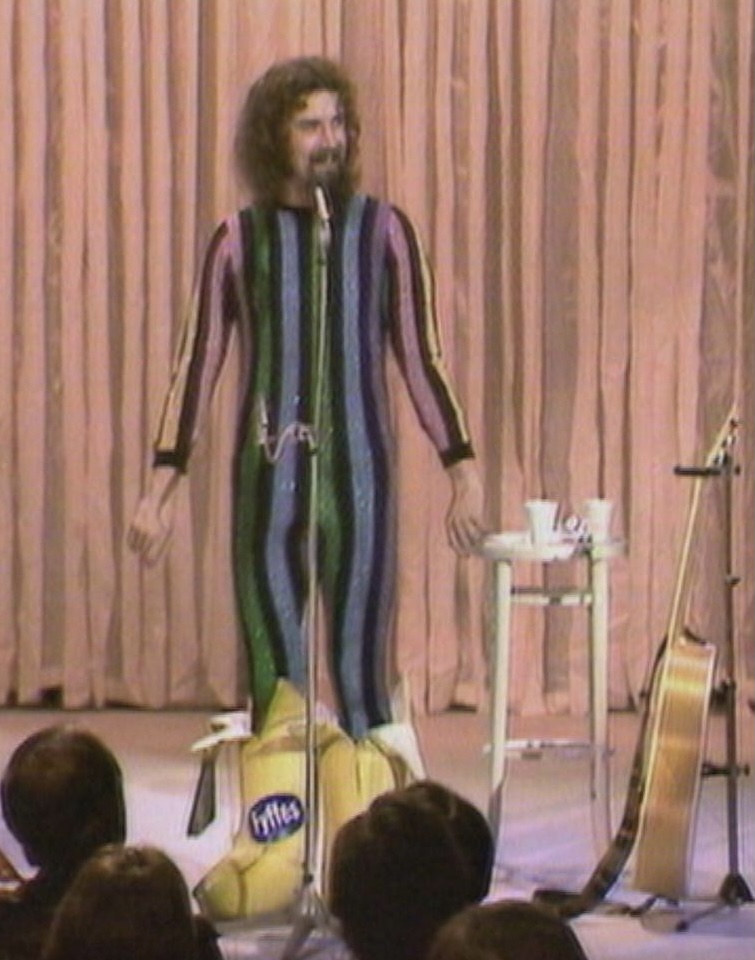
In modern comedy you will expect to watch people preform observation or situational acts, gags about things we can all relate to. Conolly’s ability to find humour and absurdity in the mundane was unrivalled, be it a floating jobby in a public toilet, the scenes of a house party or losing your virginity. Stories told every day in the pub were now being told on a stage with a theatrical twist. Billy effortlessly timed his physical comedy with these hilarious tales while clad in flamboyant attire, skin-tight trousers, vibrant shirts, banana shoes or a multi-coloured bodysuit. Evoking the figure Medieval Jester, Billy understood he had to complete the act by looking the joke.
The Jester is symbolic of common sense and honesty. He holds the ability to peer through the bullshit and hypocrisy of society and make light of the everyday tragicomedies we all experience, without fear of retribution. The Jester’s role was to find humour in the unmentionable, to make an audience feel safe in laughing at the taboo because the attention was all on him. Like the Court Jester, Connolly was daft, irreverent and carnivalesque. He mixed physical comedy with the scatological and self-persiflage humour. His language was guttural and rich with expletives. He turned swearing into an art form and celebrated the infinite plasticity of the word ‘fuck’. Billy Connolly became so recognised as the nation’s official modern Jester he could tell the Queen to fuck off and still get a laugh from the Royal Box.
A comedian’s responsibility to explore and agitate the boundaries a society’s values never goes without its controversies. One particular story, told during his 1974 Solo Concert show, propelled him into the spotlight for both hilarious and contentious reasons. In the act, appropriately named The Crucifixion, Billy set the scene of the Last Supper but highlights the Bible’s misprints. This iconic religious event actually took place in Glasgow’s Gallowgate, more specifically the famous Saracens Head pub. The story portrays the apostles as a bunch or rowdy drunks waiting on the ‘Big Yin Jesus’ before he ends up crucified and giving the Romans abuse for having shite patter. The joke, by modern standards doesn’t appear overly offensive, but in a bigoted fuelled 1970’s Glasgow this was condemned as utter blasphemy. But protests from priests and Godfearing followers wouldn’t deter Billy or make him express regret, declaring it would be fascist if he apologised for having a point of view.
This week we discuss a condition we all suffer from, chronic Scottishness or more specifically a symptom of this life long affliction, Scottish Miserabilism. Much of Scotland’s cultural output is synonymous with tragic down and outs, bleak realism and the negative story, we want to ask why? You can find our latest Culture Patter Podcast below or on all podcast platforms – @ThePatterPod
By Jamie Watt
‘Scottish Miserabilism’ – not a genre perse but a trope, a dark vein that runs through the cultural landscape of our nation. Engrained in our collective psyche, it influences how the world views Scotland and how we perceive ourselves. Much of Scotland’s artistic output is synonymous with tragic down-and-outs and bleak realism. We want to discuss ‘why?’
What are the contributing factors of SM, what historical events made the negative story so enduring in Scotland?
Socio-economic issues and legacy of Thatcherism has undoubtedly influenced modern Scotland. The deindustrialisation of the 80’s pushed proud workers into unemployment, unsatisfying jobs or poverty. Drug use spiked, as did gang violence, vandalism and incarceration. During this period naturalistic writers of ‘Clydesideism’ like James Kelman and William McIlvanney became key voices in Scottish literature. Kelman’s Miserabilist masterpiece ‘How Late it was How Late’, controversially won the 1994 Booker Prize. Throughout this period, the failures of the Modernist vision of council estates came into focus. Communities were uprooted and housed in beak, cold environments, lacking in recreational facilities. They fell victim to neglect from council authorities, under pressure from increased budgetary cuts. These environments quickly descended into post-industrial wastelands. The council flat has become emblematic of one extreme of the Caledonian Antisyzygy (the duelling polarities within the Scottish psyche) the other being the High Romantic Highland castle.
Miserabilism can be understood as a retaliation against this Romantic, idealised notion of Scotland, prevalent until the early 20th century. A repudiation of the twee, coothie, over-sentimentalised, shortbread tin depiction of Scotland. And, despite the self-perpetuating negativeness of miserabilism, it can have constructive role in analysing the hypocrisies, shortcomings and taboo subjects of modern Scotland. Transgressive in tone, is used by artists to commentate and bring into focus the ugly realities of the marginalised in Scotland. SM can spark debate and, at best, become a catalyst for social change.
Is Scotland suffering from a Calvinist hangover? Does it play a role in the evolution of Miserabilism? A strict Presbyterian doctrine manifest in Scotland in the 16thcentury, as the Kirk preached the humble life was the path to paradise – sticking your neck out or being ambitious were frowned upon. Is this attitude the embryonic Caledonian Cringe? – The doctrine of self-hatred that refers to the Scots’ lack of personal and political confidence in their ability to govern themselves.
Is SM and the Caledonian Cringe a symptom of a lack of national confidence? Modern Scotland find herself in a unique constitution situation. There is an ambiguity surrounding what ‘Scottishness’ is. Despite being one of the oldest nations on earth our parliament is only 25 years old. At present we are a pseudo-nation, within a Union whose future grows increasingly unclear. We are a wealthy nation but generations of political miss-management at home and under Westminster rule has meant, historically, one of Scotland’s truths is extreme inequality.
How Scotland is portrayed in art and media matters. Prior to the 2014 Independence Referendum David Cameron met with Sony over the release of Outlander. The establishment feared it would fuel nationalistic sentiment and manged to delay release. There was a political incentive, to repress the celebratory or Romantic notion of Scotland. These pieces of film/media/art have influence, they seep into the national psyche. Is it in Unionists’ interest to perpetuate Miserabilist stereotypes?
After recording this episode, we acknowledge the difficulty that we had, as four Scots, in discussing Scottishness – it became like fish trying to describe water. We live and breath a Scottish reality and the aspects and qualities we think are unique to Scotland might be anything but. However, rather coming to concrete conclusions our objective with the Pater Podcast is to discuss and explore. We welcome any feedback or critiaue, so please get in touch.


 thepatterpod.com